
Halo: Elegy
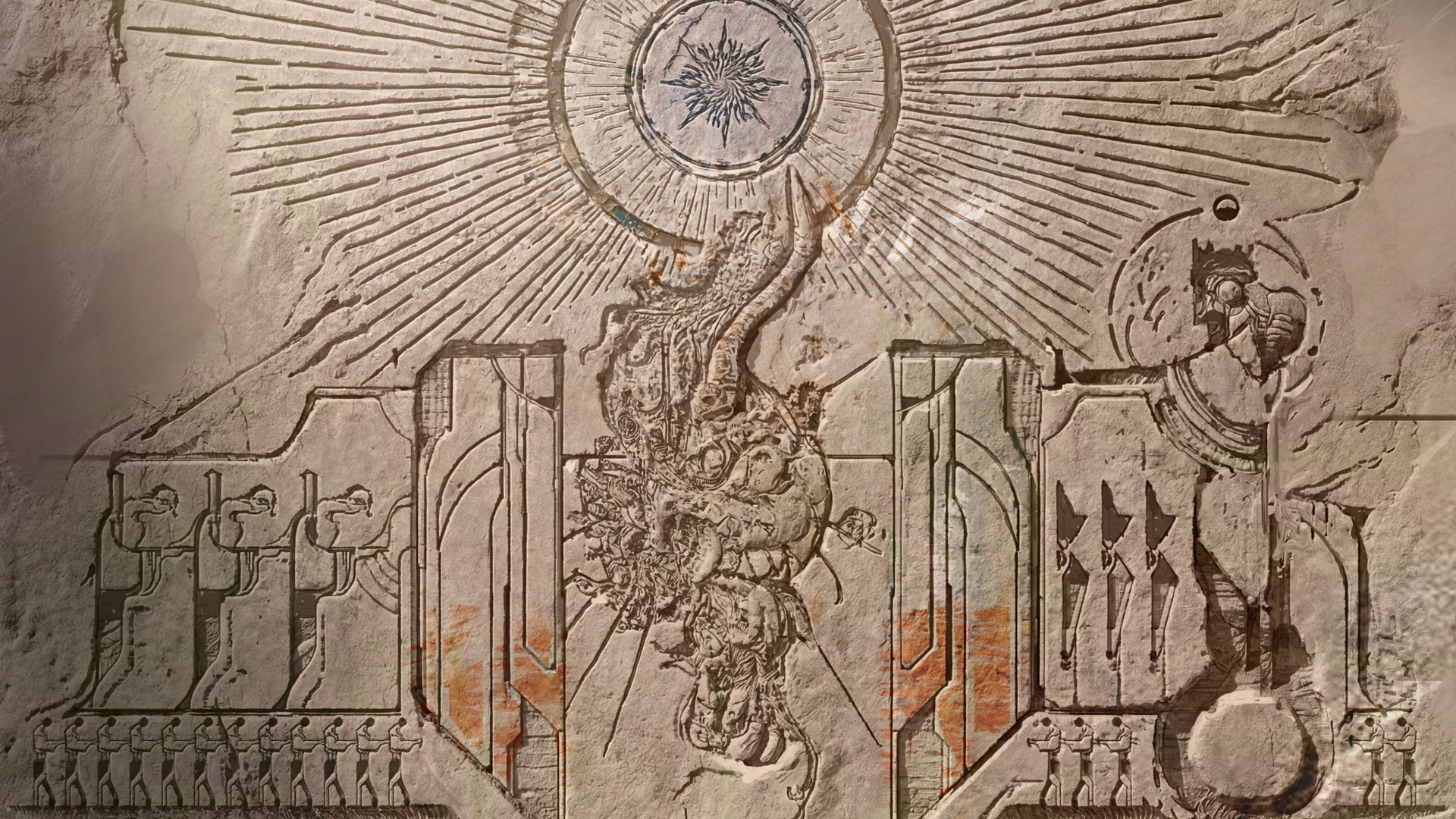

HISTORIAN’S NOTE
This story takes place on August 3, 2559, approximately four months before the UNSC Infinity deploys to Zeta Halo (Halo Infinite) and the concurrent Battle of Boundary (Halo: Empty Throne)
Cycle 220, Unit 142, Nineteenth Age of Abandonment
Faithful Perseverance, Zethro'Kal System
The heavens above Muunsami were unusually clear when the burning sun finally emerged from the edge of the world, bands of light piercing the sky before flitting atop the ocean’s brackish surface. Looming high above was the faint rim of the gas giant Dokra-Movi, giving rise to a kaleidoscopic display of brilliant colors that could be seen from almost anywhere on the western hemisphere of its ocean-moon. A remarkable beauty, but one only a few thousand would have the pleasure of beholding. What had once been an indomitable Covenant fortress world and the wellspring of seemingly limitless Forerunner discoveries, Feldokra—known by most as Faithful Perseverance—now only hosted a fraction of those who once had called it home. Razed and ruined during the Great Schism and the tumultuous Blooding Years which followed, the moon, like many of those who had survived the breaking of the Covenant, was now only a shadow of its former glory.
Some shadows, however, run deeper than others.
Such was the great lunar rift long ago named Elegy.
Resting his weight against the side wall at the stern of his pelasar-skiff, the old, sinewy claviger patiently waited for his contact. He stared out across the broad stone landing to which his vessel was docked, and into the dense foliage that crowded every corner of the atoll before him. He was looking for some sign of movement.
The island to which the landing had been fixed was one of nearly two hundred scattered across the great waters of Muunsami. What made this landmass unique, however, was that it stood right at the edge of Elegy, its terrain and waters suddenly shorn off against a vast spherical force-field that encompassed—and indeed had forged—the entire rift. The claviger’s skiff was docked at the far side of what appeared to be an immense yet perfectly spherical chasm, the sheer edge of the atoll, one of only a handful of terrestrial access points along the rift’s circumference. Its strange and peculiar energies held stone and water, ground and ocean at bay—an invisible wall that made the natural landscape seemingly defy physics.
Over a hundred kilometers in diameter, from space Elegy looked something like a bottomless crater, a hole so deep that light never touched its floor, so perfectly round that it could not have been formed by nature. No one had ever traveled to its depths and come back to speak of it, even during the time of the Covenant. The strange forces which had forged this round cavity in the face of Feldokra had been called pelasar—meaning “to hold back” or “to buoy”—by the ancient Sangheili who had first colonized this world. The claviger’s vessel, a double outrigger capable of riding those energies, had been inherited by him in the long, unbroken tradition of his keep, passed down from one son to another since those earliest years. Only a handful of clavigers remained alive, stationed at various points along the edge of Elegy, offering passage across it.
In a kind of absurd irony, even the most technologically advanced ships of the Covenant could not access the pelasar field, their machinery abruptly terminating on contact, sending the dead craft plummeting into rift depths, never to return again. In hubris, hundreds had attempted. All had failed. The only vessels which could travel across the great rift were those primitive ones fashioned by the ancient Sangheili, employing minerals and tools conversant with the force field. And the only reason travelers had ever visited was the Lonespire, a towering Forerunner temple at Elegy’s absolute center. Clavigers were those who kept watch over the Lonespire and ferried pilgrims to pay homage to it, just like the mysterious contact the grizzled Sangheili waited for now.
And just then a lone figure appeared, approaching from the atoll’s tree line.
The contact.
Clothed in a dark gray cloak, its hood concealing his face, the Sangheili moved with the steady gait of a warrior, but one who had seen his fair share of injury. He passed across the landing as the claviger glanced at his time piece.
“You are the claviger?” the stranger’s gravelly voice uttered.
“I am,” he responded, folding his bony arms over his flight tunic. “Come aboard.”
The stranger ascended a ramp leading to the skiff’s deck.
“I received the advance from your courier,” the claviger spoke as he moved toward an elevated control dais at the center of the vessel’s upper deck. “But, as I stated in our communique, I require half the remainder in order to set off. The other half can come at the completion of your journey.”
The stranger did not hesitate, hefting a satchel of coinage onto the control dais with a resolved thud—the equivalent of gekz for those who still conducted trade on Feldokra. The cloaked Sangheili simply stared at the claviger as if tempting him to count it before them both. He would of course not, for they were both Sangheili. The right amount was most certainly there.
“Very good,” the claviger replied. “You are welcome here on the upper deck and its compartments. The subdecks, however, are restricted.”
The stranger gave a single nod and proceeded to the skiff’s bow, staring out across the rift.
At the claviger’s command, the vessel released its anchors from the landing and was gently carried through the air, over the great deep of Elegy as if held aloft by some gravity-mitigating system. Yet it was not. The skiff simply rode atop the ancient pelasar energies, created by the ancient Forerunners countless generations before the Sangheili arrived. The vessel itself was long and slender, five meters in width, but three times that in length, crafted mostly of wood. It housed no advanced technology or machinery, as all machine devices would be rendered powerless within the field. Extended out from both sides were stone outriggers, forged from ancient materials by the claviger’s ancestors.
After they set off, a full unit passed in complete silence before the claviger finally descended the control dais and approached the stranger. Soon, the Lonespire would be in view—still distant, but visible. It would take several full units before they reached it. The stranger’s attention was not focused on the fore, however, but off the starboard side. The claviger turned to see what he was observing.
“Melak’tenah,” he said, as if answering the stranger before he would ask.
“Sky leviathans?” the stranger asked, his sage-colored eyes lighting up.
The claviger nodded.
A herd of large, flying beasts brooded over Elegy in the distance. Enormous, hulking cetaceans who roamed the skies of this world. So large, they demanded humility from any close enough to experience their scale and majesty. Despite their size and imposing form, melak’tenah were generally harmless. This particular species was native to Feldokra, one of the many worlds the Forerunners once possessed. Despite the devastation wrought by the rending of the Covenant, these creatures still thrived in its skies.
“Once a revolution, they are drawn to the pelasar and come out above the rift and give birth to new calves,” the claviger explained. “The energies aid them in the delivery process. But they are matriphagies.”
The scarred face of the Sangheili contorted with surprise at the claviger’s words.
“They eat their mother?” he asked.
“Yes. The mothers die in calf-birth, but their body provides the new creche with enough energy to leave Elegy and return to their homes. They will grow into adults and one day repeat the process.”
“It is grotesque,” the stranger growled, staring back toward the flying herd.
“Perhaps,” the claviger replied, his own eyes following suit. “But I sometimes think it is an apt parable of the Sangheili—what we have become.”
“How so?”
“This world, for instance. Once it was a strong fortress for the Covenant, a source of great nobility and power. And before that, it was home to our sea-faring forefathers, the boldest of our people. You know this because I can see from the tint of your eyes, that you too are a son of Feldokra. We were a great people once, those who dwelt atop the waters. And yet these days our world is treated like little more than the carcass of a dead mother, pillaged by those it gave life to until there is nothing left. All I see now are marauders and thieves, those looking to pillage the little meat that remains on the bones of this dying world.”
The stranger huffed, either displeased by the claviger at guessing his provenance or by the inference made by his own visit to this world.
“Then let it be a parable,” the stranger replied. “The Covenant’s gods were false. People must take what they can and build a new world even if on the bones of the old.”
“That may well be,” the claviger sighed. “Is that what you are doing here—seeking some treasure in the Lonespire to pluck?”
“My quarry is my business,” the stranger said tersely, turning to look the claviger directly in the eye. “And I paid a handsome fee that it would remain so.”
The stranger’s mandibles clamped down with the authority of a commander. The scars on his face went taut. This Sangheili had clearly seen his share of war in his time. The claviger, far older and weaker—and having only viewed war from a distance—was in no place to argue.
“Very well,” he said, returning to the control dais. “Though I am sure you know it already, I will say it anyway: The Lonespire can only be accessed two times in a day-cycle. Sunrise and sundown. When the light of our world’s star shines into the spire’s apex, a doorway opens for a single cental. You will gain access tonight at sundown, but you will not be able to leave until dawn’s first light...”
The stranger stared intently as the claviger continued.
“And if you do not leave the Lonespire by sunrise, I take my skiff and depart. It may well be a very long time before any other claviger returns. Very few visit Forerunner temples any more.”
In a short while, the Lonespire came into view against the slowly westering sun. First, it was a mere twig in the distance, a vertical line hovering above the dark abyss of Elegy. Then a limbless tree, growing slightly larger. Then it grew and grew, over several long units of silence between the two Sangheili, until it was at last the impossibly tall monolith that had garnered the awe of Sangheili generations before.
Nearly a kilometer from top to bottom, the single, isolated spire hovered at the center of the great rift by an endless supply of Forerunner power. It had been fashioned from what appeared to be primitive stone-like materials of another epoch—brown, gray, and with a tinge of green, its surface weathered by the long passage of time. The spire had generated the pelasar field for millennia unnumbered, hollowing the sphere into the face of Feldokra. Ironically, because of its lack of accessibility, this was the only place on the entire moon that had been unspoiled by the Covenant’s activity and the civil war that had broken the great empire.
What the stranger sought, however, was still unclear to the claviger.
The temple’s massive interior and its many corridors were by now completely empty. In the days of their forefathers, the site was only ever used as a place of gathering and worship. All that remained within it was the inextricable Forerunner technology which powered the spire and their sacred writings on its interior walls, as well as the ancient Sangheili’s own religious script painted alongside, a feeble effort to translate the words of gods. Of course, such writing had little value in the godless age in which they now lived.
So what could you possibly be looking for my fellow worldling?
The claviger eventually returned to the bow where the stranger had remained all this time, standing silent for the length of the journey, hands folded behind his back.
“Lonespire,” the claviger nodded toward the sight that loomed before them.
“Tell me, claviger,” the stranger now faced him directly. “Why do they call it Elegy? I was never told how it received its name.”
“It is a dirge of the old world, a song of sorrow and loss by the Forerunners. One of the many truths excised by the San’Shyuum, for they could not stomach something they could not understand. Elegy has always remained a mystery to them, as it had to our own people for generations before.”
“What then is this dirge about?”
“Some hold different opinions, but I believe it is a song for those who fled long ago. The pelasar created a vacuum of space to mourn the gods’ departure, when they escaped the parasite and entered divine glory. Elegy is empty because the ones who built it are absent.”
“And forever will they be absent,” the stranger huffed. “The Forerunners were mere creatures, just like the Sangheili. We have wasted many generations worshiping them.”
The claviger responded almost too quickly. “Are you then continuing in that error, stranger? No matter your intent, your presence pays homage to the Lonespire. And to the Forerunners. Whether they were gods or not, we cannot say for sure. I only know that their handiwork united the Sangheili for many ages.”
A long moment of silence passed before the stranger spoke.
“Do you believe the Covenant will one day be resurrected, claviger? Not according to the lies of false Prophets or the ambitions of warlords, but according to those who could rightly see the truth?”
The claviger held the stranger’s gaze, his eyes wet, his hearts longing.
“We have arrived,” he said abruptly, turning back to the spire as he swallowed hard. “And just in time. Sunset is less than a quarter-unit away. Let us disembark quickly and I will take you to its entry.”
The claviger returned to his control dais, deploying the skiff’s anchors as the vessel approached the Lonespire’s base. Like the ramp on the stern, there was another on the bow. With a muffled thump, the vehicle halted its movement atop the pelasar and came to rest, docking at the spire’s own landing. The cloaked Sangheili turned back to take another look at the remarkable expanse behind them, its far shore barely visible from this great distance. Elegy—a cavernous sphere bored into the face of Faithful Perseverance. It was an astonishing sight from this position, but the product of a creature and not a deity.
Turning back toward the Lonespire, the cloaked Sangheili continued to feel gripped by the awe the tower provoked in him. Old habits die hard. Over three millennia of religious rigor was difficult to shake free from the heart of a species, even now that its falsehood had been so manifestly revealed. A tower of such scale could awaken wonder even in the most unreligious. But the claviger was correct: With the Covenant religion there had been order and with that order, purpose—a purpose inseparably linked to the unity and glory of the Sangheili.
Descending the ramp, the lone Sangheili’s thoughts were a brutal tangle of conflict and betrayal. What happened in the units that lay before him could upend all that he presently held close.
“Come. The entrance is not far,” the claviger said, passing him by without a look. It was clear that it was not his first time here.
It was, however, the cloaked Sangheili’s first. Even though he was a son of Feldokra, he had never made a pilgrimage to the Lonespire. And why would he? As with most male Sangheili, he had spent more time away from his homeworld than present on it. The Covenant had been everything to him, their campaign had been the purpose of his life. It provided meaning, honor, and stability. Even when his own keep and family had been washed away by war and cataclysm, the Covenant had been his home.
The Sangheili trailed the claviger closely as they passed across the landing, a jungle of oddly angled columns and beveled Forerunner structures without any clear purpose. From the base of the Lonespire, the great tower climbed so high that he could not now see its apex. Its surface a ruddy bronze, aged yet resilient against the unyielding passage of so much time.
He knew well that the Sangheili who had first discovered the Lonespire treated it as a place of worship, but when the San’Shyuum arrived and their own technology could not traverse the rift, it was esteemed of little value. In an ironic twist however it had been one of their own, a San’Shyuum who claimed to be the oldest of their kind, who had incited this particular Sangheili’s current pilgrimage.
The claviger continued down what appeared to be a pathway flanked by thick, heavily engraved pillars, coming to a stop before a recessed wall. The entrance.
“One cental,” he said, looking at his time piece then back toward the descending sun. “That is how long the door will remain open. Once inside, you will be alone. The sanctuary will provide you light, but you will not be able to leave until dawn, when it opens once more. Remember—”
“I heard you before, claviger. I will see you at dawn.”
The claviger gave him a long look, interrupted only by a dense thrumming that sounded from the tower, somewhere far above them. They both turned their eyes to the sound, though impossible to see.
The light of the westering sun was touching a machine at the tower’s apex, signaling its systems to grant access. Why the Forerunners had constructed it this way was an enigma, even to the Sangheili who had long worshiped here. They were not gods but they knew of things that even the long ages of the Covenant, standing atop so many Forerunner achievements, could not hope to understand.
The recessed wall now began opening with the grinding sound of stone moving against stone.
The claviger gave him a single nod, and he entered the doorway. Within was a dimly lit antechamber, as cold and dark as a tomb. He looked back at the claviger just as the door began shutting. With a heavy thunk, the door touched the ground and he was alone.
He breathed deeply, his eyes adjusting to the soft artificial glow that rimmed the walls where floor met ceiling. Within a cental his eyes had adjusted well enough. He pulled back his hood and took in his surroundings. He was not one for subterfuge, but anonymity was important for this journey. He did not want his presence here to be known, not even by his allies—in fact, especially not by his allies.
Reaching into the folds of his cloak, he retrieved a narrow rectangular stone roughly the width of his palm. It was symmetrical, like an elongated box, strange geometric patterns running across its surface. The San’Shyuum who gave it to him called it a cypher-stone. With the gentle press of a glyph on its face, a dim light fanned out from the opposite side, bathing the room before him in a pale blue glow.
He was almost surprised. No technology functioned within Elegy—the pelasar field, he had been told, neutralized all foreign energies, whether craft, weapon, or tool. Everything within the field must be analog and rudimentary, except apparently for this Forerunner machine he held in his hand.
He moved forward into the only corridor before him, which jutted back and forth, weaving deeper into the Lonespire. He had the entire night to find what he sought, but he did not know how long it would take him—in fact, he did not even know that he would find it. The first corridor finally opened up into an immense space, so large that he would have assumed that he was outside again if it were not for the almost total lack of natural light. This must have been the central chamber of the Lonespire. Its ceilings so high that it appeared to have none resolving in a fog-swept darkness so high above.
The Sangheili surveyed its grand scale, its full width roughly that of the length of a corvette. It was filled with the typical Forerunner eccentricities scattered about: raised platforms linked by ramps and bridges, holographic calligraphy floating above pedestals, and other inexplicable geometric structures. They each likely had a precise utility toward maintaining and calibrating the machine that was the Lonespire, but all of it was lost on him.
Along the chamber’s outer wall were many doorways, leading out to various compartmentalized spaces within. So many of them. A heavy sigh escaped his mouth. For the first time on his journey, he wondered if he might actually be searching all night for his quarry.
So, the Sangheili began the only way he knew he could—with the doorway nearest to him. Through a beveled archway he entered into yet another corridor. He continued as it turned sharply, zig-zagging a few times before reaching a second room. Significantly smaller than the first but filled more densely with its own collection of structural elements, he knew that these peripheral rooms would be the focus of his entire time in the Lonespire. More specifically, the writing on their walls.
The Sangheili saw a myriad of ornate engravings, markings of the Forerunners followed by the comparatively crude interpretations of his own forefathers, the first Sangheili colonists. Both were inscrutable to him as they presently were, but as the light of the cypher-stone was cast against them, faint holographic symbols began to appear. Words he knew. Some of the Forerunner text was still unclear and left blank by the cypher-stone, for the Forerunners had many languages and his cypher-stone had limitations. But the words of the Sangheili—the very reason he had come to Feldokra and the Lonespire—were translated with perfect clarity.
So, he began his work. Starting with the first room, he read through every word of his own people, only ever so often glancing at the words of the Forerunners for reference. He then continued from room to room, from word to word, unit after unit until the night had grown very long.
He did not grow tired, however. Only angry.
He was beginning to think that this was a fool’s errand and that he was the greatest of all fools.
A fool is better than a traitor, yes?
Most of the Sangheili writing was composed of misunderstandings at best and complete mistranslations at worst. What his people had regarded as sacred scripture and the poetry of divine beings, was mostly technical information on machine operations and data accumulation. Whatever the Elegy was to the Forerunners, it was not religious. They were speaking about utility and function, while his own ancestors thought it was the holy language of transcendence.
This was not a surprise to him, however. He had lived through the Great Schism. He had witnessed firsthand the grave error of the San’Shyuum. The Sacred Rings. The Great Journey. Halo.
Silly fictions.
What was surprising, however, was the very fact that this error had not originated with the Covenant. His own people were making this mistake long before their war with the San’Shyuum, long before the peace established by the Writ of Union. This information was novel. He had assumed for so many years that the San’Shyuum were singularly behind the deception of his people. He was now being forced to see the truth over and over, on every single wall they had failed to properly translate. His own had deceived themselves long before they ever encountered the San’Shyuum.
After six excruciating units, without finding even a hint of his quarry, he felt on the verge of crushing the cypher-stone and returning to the entry. He was not an interpreter or scribe, he was warrior. If the truth took this long to discover, it might be better to live a lie and continue with the life he already had. Killing enemies came naturally, repeatedly reliving the foolishness of former generations did not. Walking away now would allow him to avoid betraying those he cared for most.
But then he found it.
A story. An epic. A saga of the old world.
After mistakenly explaining the holy purpose of a generic power generator at the center of this particular room, the writing soared into an epic poem about an ancient hero on Feldokra—indeed, the hero, as far as this Sangheili was concerned. A great uncle of his own keep many generations before his time, during the War of the Beginnings. He read the poem once. Then again. And again. And again.
He had finally found what had been promised.
The truth.
Blademaster Vul ‘Soran had only met High Lord Dovo Nesto once before.
The day that he had made this promise.
Nesto was allegedly the oldest of all San’Shyuum and had survived the breaking of the Covenant. He led the Order of Restoration, what ‘Soran understood to be an effort to reverse the tragedy of the Great Schism and resurrect the Covenant to its former glory under the direction of a revitalized San’Shyuum.
He was also the blademaster’s sworn enemy.
The prey he had desperately sought through the twilight era of his military service.
‘Soran had procured intelligence in the backwaters of Sanghelios and provided it to his shipmaster and close ally, Rtas ‘Vadum, a preeminent leader within the Swords of Sanghelios. Based on that information, the shipmaster deployed a small strike team, led by ‘Soran, to infiltrate a high-profile corvette named Solemn Anchorite. The vessel was alleged to be the property of various criminal San’Shyuum that ‘Vadum’s ship, Shadow of Intent, had been tasked to bring to justice after the fall of the Covenant. Rumor was that it may have even held Dovo Nesto himself. At all costs, the Swords sought to prevent the reformation of the old empire and neutralize any emerging San’Shyuum threat.
The blademaster had attained this knowledge through trusted sources and was eager to prove himself. Age and fatigue had clouded his vision as of late. He felt old, outstripped, and possessed only half the speed and dexterity of his youth. Yet, after clearing the corvette of a surprisingly light opposition, ‘Soran’s team found no sign of Restoration leadership. Not a single San’Shyuum, nor the evidence that one had even been on the vessel. This mission—his mission—had suddenly become gross expenditure of resources, and a failure by any standard. Had this been the first time his intelligence had yielded fruitlessness, ‘Soran might not have felt so shameful. But it wasn’t. He was slipping and others were taking note, he could tell as much from the tone of his shipmaster’s voice after relaying the news.
Sending the strike team back to Shadow, ‘Soran remained behind to personally strip the ship’s navigation database and its communications logs—and to steep in his own rankled humiliation. All might not be lost, however. Perhaps there was data on Anchorite which could salvage this operation, something that might wash away the disgrace. He ventured to the empty command deck and began acquiring the data from the control console, when all doors sealed shut behind him. He attempted to hail Shadow of Intent but could not get through. Then he heard it.
The voice of a San’Shyuum.
“It is a blessing to finally meet you, Blademaster,” the voice spoke as particles of light atop the deck’s holotank materialized into a pale shape. “You remind me of someone I knew long ago. A great warrior. A faithful ally. A friend.”
Before ‘Soran now stood the high lord of the Order of Restoration himself—Dovo Nesto. The blademaster fought against the instinct to lay hold of his twin energy swords and run the San’Shyuum through right then, but it was only an image.
“Though it doubtless comes as a surprise to you, I have long desired this moment,” the San’Shyuum continued, a grin spreading across his face.
“What manner of villainy is this?” ‘Soran growled, searching the deck. “Show yourself, coward!”
“I am quite far from Solemn Anchorite, Blademaster,” the San’Shyuum replied with a calm tone. “But know that the information you provided to your shipmaster was not in error. It was, in fact, engineered for this very meeting. We must speak, Vul ‘Soran.”
The bladmaster attempted his communications link with Shadow again, but it failed.
He was clearly being jammed.
“What do you want with me, you snake?” he growled.
“To make you an offer, the rightful descendent of the great Batar ‘Soranu.”
The blademaster knew the name well. He was a legend on his birth world, Feldokra. Indeed, he was his world’s leader when the Writ of the Union was signed, a great warrior known for establishing the peace and unity of his people for many generations that followed.
“Blademaster,” Nesto continued. “I know your allegiance to the Sangheili. It far outweighs all other loyalties. That is not by happenstance. You are the fruit of a long lineage of faithful warriors, many of whom worked shoulder-to-shoulder with my kind. Even me.”
‘Soran’s anger continued to climb, but there was nothing he could do but listen.
“I speak of Kaidon ‘Soranu. During the War of Beginnings, it was he who parleyed with me. He fought for an alliance when we were at each other’s throats. He saved both our peoples.” Nesto looked off into the distance as if fondly cherishing a moment from his past. Then his face intensified, focusing in on the blademaster as he continued. “You now must take up that standard.”
“There is no standard to take up,” ‘Soran shot back. “The Covenant is dead. Killed by the lies of the Prophets.” He stepped forward, rage seeping through every word. “Killed by your lies.”
It was bad enough that this San’Shyuum was not restricted to a mobility throne like the others of his kind. He spoke of being alive many ages ago with the casual repose of one who actually had. He was somehow youthful yet ancient, lithe but peculiarly strong.
“Lies were certainly told, Blademaster, but not by me.” Nesto lifted a fist. “And those who told them have paid for those heresies with their lives, which is precisely why I have come to you.”
“Me?” ‘Soran laughed at the absurdity. “Are there not countless groveling malcontents at your beck and call?”
“I have many followers, even among the Sangheili, but they are not leaders. Not true leaders. You, ‘Soran, are my equal—not a follower. I can see it in your eyes, the very eyes of your greatest ancestor.”
“Do you think me a fool, worm? These are nothing more than new San’Shyuum deceptions. If you were here, I would crush the life out of you with my bare hands.”
“I do not doubt you could, but I am not lying, Blademaster. I knew Kaidon ‘Soranu. It was I who made peace with him long ago—”
“That was nearly three and a half millennia ago.”
“Indeed, and yet it is so,” he said with a smile. “And I trust that you will come to know this truth on your own. In the compartment just below the deck is a cypher-stone.” The compartment opened on its own, revealing a long, engraved device. “It is a Forerunner tool which can translate their language, even the writings of your earliest ancestors. This is one of only three but it now belongs to you, Blademaster.”
“What do you want of me?” ‘Soran’s venom had died down. He would play this out, not only because he had no other choice, but because a strange curiosity had sprouted in his heart.
An alarming curiosity.
“Go to the Lonespire, search out its inner sanctums. Find the saga wall of your people that bears this story and learn of the past. Your forebearer worked side by side with me and became one of the first Sacristan warriors. Together, we helped build the Covenant, united our peoples, and attained the glory both our kinds lack alone. Yes, ‘Soran, the old gods failed us. But their machines still possess great power. From the ashes of this failure, we can rise and rebuild. Indeed, we must. The Swords of Sanghelios cannot accomplish this. Only the Covenant. Unite your people, reclaim their glory—glory the humans have trounced upon and dragged down with them into the mire of their own filthy abasement. Together, we can reestablish the preeminence of the Sangheili side-by-side with the San’Shyuum. I need only a faithful commander at my side who can lead them. I need you.”
“I am an old warrior . . .”
“Which is precisely why you are perfect. All others under my command are mere children, muddled by untamed zeal. You served the Covenant before our war with the humans even began. You know the long road of war; you’ve tasted the days of glory your people enjoyed prior to the Schism.”
“You do not understand,” the blademaster said, his tone resigned but his mind tracing out the words of the high lord. “I am well beyond my prime, only good for drunken fables by the hearth.”
“No, blademaster. Your greatest days lie before you,” Nesto’s eyes gleamed bright as he continued. “I possess god-machines which can give you back what age and war have stolen. Technology that can heal old wounds and restore the years of your youth, that can give you the strength to lay hold of the nobility and pride of the Sangheili and return your people to their rightful place. Vul ‘Soran, I see it clearly. You will lead our Covenant as one of your judge-kings of old, and you will be the one to establish the legacy of the Sangheili above all others. Together, you and I can usher in an age of reconciliation, the rebirth of the Covenant. San’Shyuum and Sangheili side-by-side.”
“And what of the Arbiter?”
“Thel ‘Vadam’s time will soon run its course. His alliance with humanity has poisoned any unity your people might have. They are more divided and more enslaved than ever before. He is shame to all that Batar ‘Soranu stood for. No. You alone can save your people. Take the cypher-stone. Test my words in the Lonespire. Become what you were always meant to be.”
The holograph suddenly collapsed to nothing, the doors of the command deck sliding open.
And everything began to change.
Vul ‘Soran’s eyes continued to read the saga before him yet another time.
Dovo Nesto’s words had been proven true.
Batar ‘Soranu, his great ancestor on Feldokra, had worked alongside the high lord so long ago to build the Covenant, to establish their traditions, and to bring peace on his world.
He served the rest of his days as one of the founding members of the Sacristan orthodoxy—the most devout clerics, scholars, and temple guardians, denoted by their distinctive ivory-bronze armor. Holy scriptures lined his arms and wrists, ancient words of wisdom and power, concealed beneath blood-dark robes. And branded on his head was the unifying symbol of the Covenant religion: a Sacred Ring, its divine energies blazing outward as the gateway to paradise opens to the worthy at the center.
The conflict in the blademaster’s hearts raged to new heights, but he could no longer deceive himself. Something had already convinced him that his path had been changed by forces far outside his control. For many lunar cycles since that chance encounter, ‘Soran had wrestled with the words of Nesto, sharing them with no one and hiding the cypher-stone. But over the course of time, wearied by the possibility of its truth, he set out during a rare moment of respite to prove it one way or the other.
And now he had.
But it wasn’t only the San’Shyuum’s words that had calcified his future path. It was the unbroken civil war that still gripped the keeps of the Sangheili despite the Arbiter’s best efforts; it was the compromise and complacency they had inculcated from human sympathies.The so-called “Concert of Worlds” would never work. Ultimately, ‘Soran thought, it was simply his desire to see his people no longer groveling for crumbs but returning to their former stature.
His contemplation was broken by the sound of the dull thrumming somewhere far above him.
Dawn.
He quickly sprinted through the corridors of the Lonespire, charging across the vast interior space as dim morning light began filtering in through the upper reaches of the main chamber. He reached the front antechamber just as the door began to open and quickly passed across the threshold.
To his surprise, the claviger was not there. He wondered briefly if the Sangheili had departed as soon as the door had closed, stranding him here. Passing quickly across the landing platform lit by the warmth of the rising sun, he saw the skiff parked where it had been before, the claviger leaning on its side wall, his eyes searching and curious.
But something was wrong.
An ugly scent filled the air—one ‘Soran recognized and despised.
“What did you find, stranger?” the claviger asked, his voice tense.
“Precisely what I was looking for.”
The claviger frowned as a series of hulking, dark figures emerged from behind him, clearly coming from somewhere below the upper deck. The blademaster had already guessed it.
Jiralhanae.
“How much did they pay you, claviger?”
“They arrived here a day before you. They knew you were searching for something in the Lonespire. Give it to them and we will both live.”
By their armor, the blademaster could tell that the Jiralhanae were clearly from the Banished, the mercenary faction led by Atriox. There were at least a dozen, all armed with staves and blades—the pelasar of Elegy preventing their customary machine weapons. ‘Soran had briefly wondered if it was Nesto who had put them up to this but quickly dismissed it. Given all that had taken place, it seemed far more likely that they were simply doing what the Banished always did.
Take.
But they could not take what he had found.
He let his cloak fall to the ground, revealing taut underarmor stretched across his body. Though he was old, it was still the body of warrior—tightly corded muscles, scarred by years of violence. He laid hold of the hilts of two curveblades made from the tusks of great dubonark ocean serpents.
“I have nothing to give them, claviger,” ‘Soran admitted. “But these.”
The Jiralhanae wasted no time, charging down the skiff ramp one by one, barreling toward his place on the platform. The blademaster sprang into action with a feverish zeal newly awakened, kindled no doubt by the emerging promise of the high lord. Prior to his encounter with Nesto, he would never have entertained any kind of peace with a San’Shyuum. He abhorred them, and rightly so. But since his seeing the saga inscribed on the Lonespire’s wall—just as Nesto had predicted—he could not imagine his future without the high lord somehow involved.
They seemed now inextricably connected, just as his ancestor once had been.
What followed in the shadow of the Lonespire was a blur of carnage.
He dispatched each Jiralhanae in their own time, rending limbs and heads, carving his way as heaps of Jiralhanae forms and dismembered body parts began to litter the Lonespire’s landing. They were formidable to some degree, but not for a blademaster, even one as old as himself. The final three slowed to a halt, orbiting him in the midst of what remained of their brothers, the platform already slick with blood.
‘Soran lunged toward the nearest, carving his blade across its chest and landing an elbow to the Brute’s face so hard that it broke its neck, its body immediately falling limp. As he moved to the second, the third raked Jiralhanae steel across his back with a stave, penetrating underarmor and flesh. It wasn’t a deep wound and for that he was thankful. He planted his left curveblade deep in the gut of the second Jiralhanae, cleaving off its arm with his right and guiding the large creature’s mass to block a second blow from the last of his foes.
With a single kick, ‘Soran sent the Brute tumbling backwards toward its packmate. By the time they made impact, the second was no longer conscious and the last disoriented. The blademaster launched atop the mass of horn and hide, looming over the third which remained pinned on its back, eyes wide. He sent his curveblade down into its face so hard that it touched the platform below. What looked back at him when he removed the blade was an unrecognizable clump of skull and flesh.
The blademaster rose among the scattered remains of his would-be executioners—covered thick in Jiralhanae blood—and turned toward the claviger, whose eyes had grown remarkably wide. Immediately, the old Sangheili ran toward the dais and the blademaster set after him, leaping onto the skiff in a single bound. He reached the claviger just as he had released the anchors and set loose the skiff across the pelasar. In a mere eighth of a cental, ‘Soran already had his strong hand around the bony Sangheili’s neck, hanging him over the side of the now-moving skiff.
The claviger clawed at ‘Soran’s tightening fist with desperation, his eyes bulging and mouth gasping. Below him, Elegy’s seemingly depthless maw was ready to consume his lithe body dangling in the wind.
“I hope the Banished paid you well,” ‘Soran growled. “Because it is about to cost you your life.”
“It was not my choice, stranger,” the claviger choked out. “As I said. They came the day before you. They are Banished. I am an old claviger. Not a warrior. How could I stop them?”
It was not the claviger’s argument that stayed the blademaster’s hand that day, nor even his own desire to guarantee his return trip across Elegy. It was the eyes of the old Sangheili, a son of Feldokra. He saw in him one of his own people, a once-great people who had remained divided for far too long. And he recognized in those eyes that the high lord was correct. They did not need the old gods to build the Covenant, they needed only the wisdom of their forebearers. Therein lay the unity of countless generations to come.
He pulled the claviger back onto the skiff, dropping him to the deck. The old Sangheili stayed there for a moment, clutching his throat as he fought for air.
“No Sangheili need die today, claviger. Get me across Elegy and I will forgive your indiscretion.” ‘Soran stared across the great rift, the far side barely visible at this distance. Dawn’s light began to climb into the sky, casting off the shadowy shackles that had shrouded this place in darkness.
He thought of the name. Elegy. A dirge, a song of sorrow and mourning over the dead. There would be no mourning today, ‘Soran thought. A new day had come.
Light would overtake the darkness, not only on this world but all worlds belonging to the Sangheili. And ‘Soran intended to be at the heart of it. When the right time came, it would be painful to break ties with his beloved shipmaster, ending the many years they had served together, and the scion he had come to regard as a headstrong daughter. But that pain would not equal what he would endure if he rejected this newfound birthright—if he remained on the outside of the very purpose his predecessors set into motion many centuries ago. He could not stomach such a thought. He cared for his allies aboard Shadow of Intent, but the only way he could truly fight for them—indeed, for all Sangheili—was by laying hold of his own destiny. In the end, they would see . . .
But that time was still a way off. There was much left to consider. Much left to plan.
“Thank you, stranger,” the claviger finally said, standing to his feet as he bowed his long neck in somber gratitude.
“Do not call me stranger, claviger. We are brothers on this world. Call me Vul ‘Soran, sireling of the great Kaidon Batar ‘Soranu. There are days of peace ahead for the Sangheili, days of unity. The Covenant is not dead, my brother. It only needs the right hands to raise it.”
ABOUT JEREMY PATENAUDE
Jeremy Patenaude was the lead writer for the Halo franchise team at 343 Industries, where his duties involved writing miscellaneous fiction as well as managing the Halo universe continuity. He began at 343 Industries as a content creator for the Halo Waypoint team, authoring most of Waypoint’s fiction content and campaign gameplay videos. He also authored Halo: The Essential Visual Guide and he is one of three authors of Halo Mythos, alongside Jeff Easterling and Kenneth Peters. He lives in Orlando, Florida.
Story edited by Alexander Wakeford and Jeff Easterling.