
Halo: Foehammer’s Last Flight

HISTORIAN’S NOTE
This story takes place on September 22, 2552, just moments after the Master Chief and Cortana cause a critical overload of the UNSC Pillar of Autumn’s engines to destroy Alpha Halo before attempting to escape from the doomed installation.
When two Covenant Banshees appeared behind her, gunports blazing, too close to escape and closing in fast, Carol Rawley did not think of duty or sacrifice.
She thought of home.
Before the Covenant came for humankind, Rawley’s greatest enemy had been her own head. As a child, it had taken a long time for her mother to realize that something was—if not wrong—not quite right with her. She’d been a quiet kid, the sort of child that would always fly under the radar on a bare-bones colony world like theirs, a planet perched at the very ass-end of human-controlled space in the Orion Arm. With the United Nations Space Command breathing down the colony’s neck whenever it so much as twitched, there were always going to be more pressing matters than a little girl who wouldn’t (couldn’t) stop sanitizing her study station in the middle of class. Why worry when she had such a wicked sense of humor? She had friends. Not many, but still. Her grades were fine.
Then Rawley had started waking up in the middle of the night to check and double-check the locks on all the windows and doors of the apartment. One night she’d knocked over a vase, and her mother ran out of her bedroom with a bat. Jan Rawley had started laughing and told her daughter to go straight back to bed, but the girl hadn’t been able to make herself stop. When her mother grabbed her shoulders in a panic, Rawley had burst into tears.
There wasn’t money for a specialist, or drugs, or one of those Inner Colony implants that just seemed to reach in and "fix" you. So Rawley got good at pretending. She came to school early to scrub her study station, and left late so she could do it again. At home, she learned to be as quiet as the vacuum of space when she crept around at night.
And the more she gave in, the worse things got. It escalated to the point where she could barely think around her brain’s incessant, firecracker demands. It was exhausting on a molecular level. If this was what the rest of her life was going to be like, Rawley wasn’t sure if she wanted to live it.
Then the Covenant ships shot into their solar system. Rawley had thought UNSC vessels were imposing until she saw images of the alien destroyers on the news. They were gargantuan, sinuous. They were world-enders. The Covenant reduced their sister world to ash and dust. The Unified Earth Government, as it was wont to do, looked the other way until the surviving refugees started whining about having a place to live. Rawley had been just as terrified as every other kid on her homeworld. But the fear—oh, the fear. This was her first time tasting true terror. It brought a clarity that made her eyes sting, even now, two decades later. She would’ve torn out her own toenails than admit it, but in a way, she was almost grateful to the enemy, because nothing was worse than the screaming, chaotic tangle that was her own mind. In battle, her brain didn’t have the time or energy to fill itself with useless, unnecessary thoughts.
In chaos, in battle, there was only blessed silence.
“Cortana to Echo 419, two Covenant Banshees are approaching on your six—”
She could barely hear the words over the alarms, the rattle of her beloved ship, the dull roar in her own head.
“Evade, say again, evade—”
“I’m hit!” Rawley yelled. The unending curve of the Halo was drawing horrifyingly close. “Mayday! Mayday! Rear port thrusters are shot to hell! I can’t hold her, I can’t hold her!”
Something in Echo 419 shrieked, steel tearing apart like wet paper. The comms were still going, but Rawley said nothing. There was nothing else to say as they plummeted down toward the ancient ringworld-cum-superweapon.
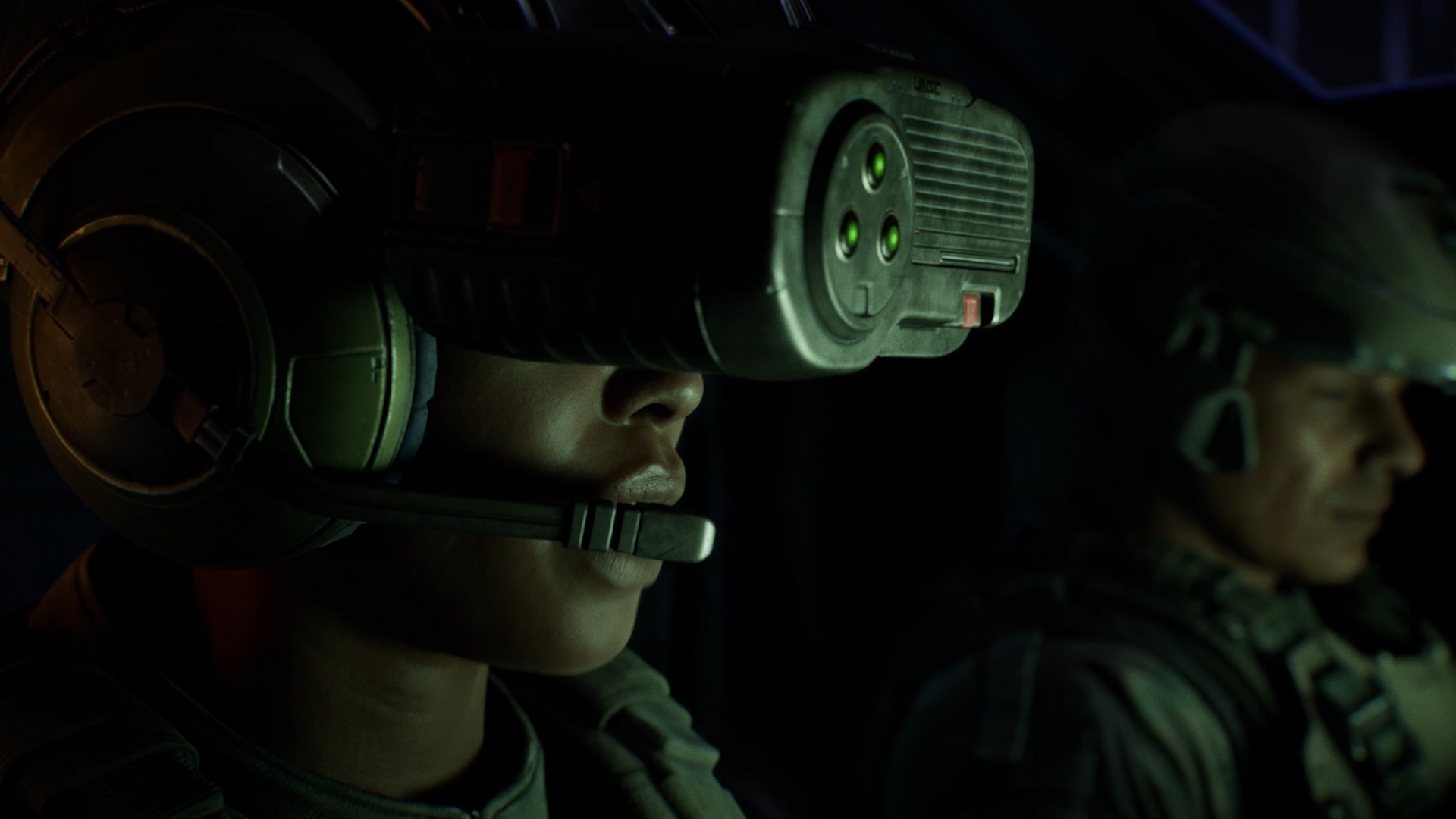
She looked to her right, her gaze latching onto that of her co-pilot as the Halo’s desert raced up to meet them, a sandy blur of gold and brown. Frye’s mouth slanted into a humorless grin. With a snap of his arm, he saluted her. Rawley closed her eyes, and prayed to all the gods she knew by name for a quick death.
“Hey, Carol!”
The voice jerked her from the mind-numbingly punishing pattern of her exercise regimen.
Rawley lifted herself from a flawless push-up and rolled onto her feet. “What’s up, Damson?”
Damson was attractive in the way that everyone from this part of the galaxy was attractive—it was always hard to tell whether it was the self-assurance and access to good dentists or if it was natural good looks. But his key trait was that he was unceasingly friendly. It was like he'd bet an outrageous sum of money he could break Rawley out of her shell. In fact, she worried that was exactly what had happened.
“Me and some of the others are heading out for lunch,” he said, grinning his enormous porcelain-white grin. “Wanna come with?”
Rawley opened her mouth to refuse, but anxiety stopped her. She’d turned down dozens of offers to hang out with her fellow pilots since enlisting. Soon the offers would stop coming, and then it would be too late to make friends by the time she worked up to wanting them. It wasn’t that she didn’t like the other hot-blooded young recruits in her cohort—she just had nothing in common with them. They were all Inner Colony kids, raised under stable roofs with three square meals a day. Until the Covenant launched their genocidal campaign against humanity, all of them had gone to bed each day comforted by the fact that any war the UNSC fought would likely never take place on their own doorstep. Even as the Covenant burned their way through the Outer Colonies, there were those who simply sat by and felt relieved that it wasn’t their problem—and if they were very lucky, it never would be.
“Next time,” Rawley told him, and she almost meant it. “Thanks, though.”
Damson looked like he was going to put up a fight about it, but then he shook his head a little and left.
Rawley clasped her hands behind her back and looked out the huge gym windows, gazing out at the towering buildings and the forest-smothered hills. The smooth gray roads and the glossy transports, the unpolluted sky and the people. So many people, talking and laughing and walking and shopping in their pretty air-conditioned stores. They had voted to brutally quell dissent in the Outer Colonies, and now they were all too happy to see yet more Outer Colony blood spilled to save their own hides.
While in school, during the few spare moments when she’d been able to make herself concentrate, Rawley had learned all about the great wars of old Earth, the conflicts that had burned like white fire across the planet long before slipstream travel. Those struggles had never seemed justified, just a bunch of powerful people squabbling over the resources of a single world. The UEG’s battles with the colonies were no different. But the Covenant offered the perfect war. Here was an enemy, ancient and powerful and set on exterminating humanity. What fight could be greater?
She would get the answer to that soon enough, in the Flood and its yawning, eternal hunger. But for then, the Covenant was cause enough.
What choice had she had but to enlist?
It was a question she’d been asking herself with increasing frequency over the past weeks.
“Weird as shit, isn’t it?”
Rawley flinched, barely resisting the urge to spin around to face the unfamiliar voice. To her side, only a few paces away, stood a young man in crisp cargo pants and a creaseless black shirt.
“I’m Frye,” he said, extending a hand to shake. “Those troopers we’ll be carrying, they have no idea how good they’ve had it.”
Rawley thought about the open-air market on her homeworld, closed four days out of every five. On the fifth day, though, there wasn’t a more alive place in the whole damn universe. She remembered children filching punches of ground pepper from huge plastic bowls to lob at unsuspecting passers-by, sending visitors into uncontrollable sneezing fits; stoop-backed grandmothers lugging pails of ice down the cramped noisy paths; uncles weighing out dishes of pickled garlic; aunties fiddling with the ingeniously simple spinning robots that kept flies off fruit and fish. You had to get all your shopping done in one day, and often half of what you wanted wasn’t available because the UNSC had blocked a key trading line or impounded a merchant ship suspected of transporting terrorists. Yet still she missed the market of her conquered home. The enormous malls here, with their antiseptic white hallways and perfect rows of perfect produce, just made her faintly depressed.
“I don’t know about good,” Rawley replied. “What does that even mean? Their lives have been easy, maybe.”
She was just being contrarian for the sake of it. The residents of the Inner Colonies have it both good and easy. For now, home is nothing more complicated than a tidy house on a rich planet. But Rawley can never go home again, not physically; even if they somehow beat the Covenant back to wherever it came from, the world she grew up on was reduced to a wasteland.
The stranger shrugged, easygoing as anything. “Either way, they’re soft, and it’s going to get them killed.”
“Not if we can help it,” she said.
“Not if we can help it,” Frye agreed.
“I’m Rawley.” She gripped his hand and shook it, hard. “You’re not from around here either, are you?”
Frye gave her what she’d come to learn were his signature lopsided smiles. One of his front teeth was chipped, and his enamel was tea-stained. “Course not, can’t you tell?”
“So why are you here, then?” Rawley asked.
“If we don’t fight to protect the fringes, who will?” Frye asked. “If the UNSC didn’t need us to fill out the ranks, they’d let all our worlds get overrun.”
That was more or less the conclusion Rawley had ended up at herself. “I thought they’d be more . . . different, here,” she told him. “But I think if our positions were reversed, if we got to live this well and their suffering was the cost, I bet we’d be treating them the same way they’ve treated us.”
“Probably,” Frye agreed, “but when this is all over—if it’s ever over in a way that doesn’t mean our extinction—I’m hoping they ease up on the Outer Colonies. Nothing unites like a war, and this time the us is all of humanity and the them want to wipe our species out for good.”
Rawley was not so sure. She didn’t remember much about what her teachers had said happened after the second-class citizens of powerful nations took up arms against a shared foe, bled and suffered and then came back home, but what she did recall didn’t fill her with optimism.
She made herself nod anyway. “Let’s hope. You hungry, Frye?”
He laughed, sharp and loud. “Always.”
“So?” asked Commander Samira Hashem. “What do you think?”
Think? Rawley couldn’t think at all.
Sitting before her was a D77 Pelican dropship, fresh off the assembly line, sleek and sturdy all at once. It was the most beautiful thing she had ever seen. She told her XO just that.
“This is Echo 419,” Hashem said. She had a face like a slab of granite with an even less yielding temperament, but her eyes—sometimes Rawley thought she saw flickers of warmth in them. Hashem tried to hide it, but she cared deeply about each and every one of her troops. That individual investment was probably why she’d never make captain. “Take care of her, and she’ll take care of you, you hear me?”
Rawley nodded numbly. Her heartbeat ticked up as she marched carefully up the gangplank and into the cool, well-lit belly of the ship.
Until she first stepped foot inside Echo 419, Rawley had never understood what people were yabbering about when they waxed poetic about falling in love. She knew family, and she knew friendship. She knew what it was to grow into a relationship with someone, slowly building up trust brick by brick, layer by layer. But to fall in love, especially at first sight—to stumble into such depth of feeling unawares—that all seemed like a childish mass delusion.
Then her XO had dragged her out of bed and introduced her to this magnificent work of deadly art.
Rawley slid into the pilot’s seat. For a moment she just sat there, savoring the moment in a way her brain so rarely let her. This ship was hers. She felt it in her bones, the truth as solid as the steel surrounding her. She would use this ship like she’d been trained to use her own body, to protect as many people as possible for as long as possible.
It was all she could ask for.
No use denying the fact of it.
The UNSC Pillar of Autumn was going down. Rawley and Frye realized that hard truth a few seconds before the others—in the Outer Colonies, you learned when it was time to run or you died. Those handful of moments proved critical.
While the rest of the ship fled in lifeboats, they led the pilots off in their Pelicans to continue the fight. And fight they did, over three terrible, glorious days.
Rawley was not sure how she felt when she first met the Master Chief, truth be told. The super-soldier unnerved her, loathe as she was to admit it. Over the last few years, she’d heard all about the Spartans. There was the propaganda, and then there were the whispers. It was said they’d been designed to put down rebellions in the Outer Colonies in between long cryogenic naps. Whether the Master Chief had taken part in those lopsided battles, she didn’t know. In truth, she didn’t want to.
It was impossible to get a read on the Chief as she ferried him from mission to mission along the Halo. He was a man of very few words, unreadable even on the rare occasion his face wasn’t masked by that golden visor of his. Even so, Rawley felt a strange kind of kinship with him for reasons she couldn’t quite explain. And his artificial companion, Cortana, often spoke like she was just another one of the marines. Rawley wasn’t sure whether that was just programming or whatever passed as “genuine” for an AI’s personality, but it was oddly comforting.
Then she saw the Master Chief in action. He was all bite, no bark. She’d never seen a better fighter in all her life. Hard not to respect that, and hard not to be impressed. Yet it was his commitment to protecting all of humanity—rather than just the core worlds—that moved Rawley in the end.
And now—
Now Rawley came to in her pilot’s chair, battered and bloody and somehow still alive.
Her helmet felt like it was crushing her skull, breaking the bone and pushing jagged fragments into the folds of her brain. Gritting her teeth against the pain, she ripped it off. She set it beside her carefully, with respect, even though she knew she wouldn’t be needing it ever again.
This was it.
This was the end.
All roads had converged here. According to Cortana, the Flood aimed to repair the Pillar of Autumn so it could leave the ring and spread across the galaxy, consuming everything in its wake. The Covenant wanted what it always wanted: to destroy humanity, and apparently to claim this ring for themselves as some sort of weapon. And the surviving UNSC forces had bought just enough time for the Chief and Cortana to overload the ship’s wrecked engines. In mere moments, the explosion would destroy the ring along with everyone on it—Covenant, Flood, and every human still on the Halo.
Rawley had no regrets.
She’d done everything she could. What better end could she ask for than to go down fighting to protect humanity against overwhelming odds? What better gift could she give the universe than her life? She’d heard that line in a speech once, back at the academy . . . or maybe it was from one of the movies she’d devoured between missions.
Either way, she felt it was true.
“Frye?” her voice was a jagged rasp. “You okay?”
Silence.
Rawley ground her teeth together. “Come on, Frye.”
Nothing.
“Lieutenant,” she snapped. “Answer me.”
Rawley dragged in a breath, then another, then another. Finally she made herself turn to look at him. There he was, unnaturally still, his unseeing brown eyes wide open. A silent cry tore out of Rawley.
She’d had close companions and comrades fall in battle before, but Frye was her oldest and best friend. The shock was overwhelming. Her ribs were folding in on themselves, squeezing the air from her lungs as they went.
A few missions in, Frye had told Rawley he didn’t expect to make it out of the war, that he didn’t even want to. His hopes for a better future if humanity survived had withered. If the UNSC fought off the Covenant—and now the Flood—he was certain that it would just turn its forces inward once again.
“If I see my family again, it would probably be to throw them in jail, or worse,” Frye had whispered, fingers twisting together. “I can’t—Rawley, I can’t.”
They’d been sent to extract a small team of elite troopers and had perched Echo 419 beneath a seaside cliff, where the Covenant’s defenses wouldn’t find them. They’d exhausted all their usual ways of killing time by then: reviewing the mission brief, checking the engines and guns, gossiping about their least-favorite baby pilots, a few games of poker where both wouldn’t stop cheating. Finally they’d given up on entertaining themselves and just watched the tides lick against the shore. Beneath the shallowest waves, ribbons of golden light rippled over red-brown rock.
Frye’s confession had come out of nowhere, and his words made Rawley feel small, so small and useless. She hadn’t been able to respond to him at all. Instead she’d squeezed his shoulder and hoped that it would be enough.
“Don’t you ever feel so alone you could crumble into nothing?” Frye had asked her, after a few endless seconds.
Coming from anyone else, it would’ve sounded too maudlin, and Rawley would’ve laughed. But Frye said those words and all she’d wanted to do was weep for him.
“Not when I’m in here,” she’d replied. That was better, but still insufficient. “Not when I’m with you.”
Rawley snarled at herself to snap out of it. Revisiting old hurts and personal failings would not bring him back. Nothing would. She unbuckled herself from her seat, but she couldn’t make herself look away from Frye. How did anyone live with this pain? Thank the gods she wouldn’t have to, not for long.
“I’m sorry,” she whispered. “I’m sorry.”
If she’d been better, if she’d flown faster and maneuvered more cleverly, he might still be alive. But here they were, both dead even if it was just taking her a little longer.
Something clanged hard against the side of the Pelican, shocking her from the typical whirlpool of her thoughts. Ninety seconds to go, if her count was right, and the battle outside had not waned in the least. She couldn’t see anything beyond the sand caking the windows, but now that the dull roar in her skull had faded she could hear the screams of the dying, the whistle of bullets through the air. Her people were still out there. They needed her help. She could still be useful, even now.
Panting, Rawley shoved to her feet and grabbed an MA5B from the weapons rack, along with several magazines. But as she stepped toward the door, a traitorous voice in the back of her mind whispered, What’s the point? You’d only be giving someone an extra minute of life at most. Just stay here. You’re all already dead. Nothing you do now could possibly matter. Who do you think you are?
She stood there for two short breaths, the fingers of her free hand curling into fists.
Then she answered: My name is Carol Rawley.
My callsign is Foehammer.
And I fight until there’s nothing left to fight for.
She turned to Frye. She brushed her bloodied fingers over his eyes, closing them, and marched to the door, lowering the ramp.
With a ragged cry, she leapt out into the sands.
ABOUT KEMI ASHING-GIWA
Kemi Ashing-Giwa is an author and scientist-in-training. Her work includes The Splinter in the Sky, which won the Compton Crook Award and was a USA Today bestseller; This World Is Not Yours; and The King Must Die. Her short fiction, which has been nominated for an Ignyte Award and featured on the Locus Recommended Reading List, has been reprinted in Some of the Best from Tor.com: 15th Anniversary Edition, The Year’s Top Tales of Space and Time, and The Year’s Best African Speculative Fiction. She is now pursuing a PhD in the Earth & Planetary Sciences department at Stanford.
Story edited by Alexander Wakeford and Jeff Easterling.