
Halo: Edge of Dawn – Preview
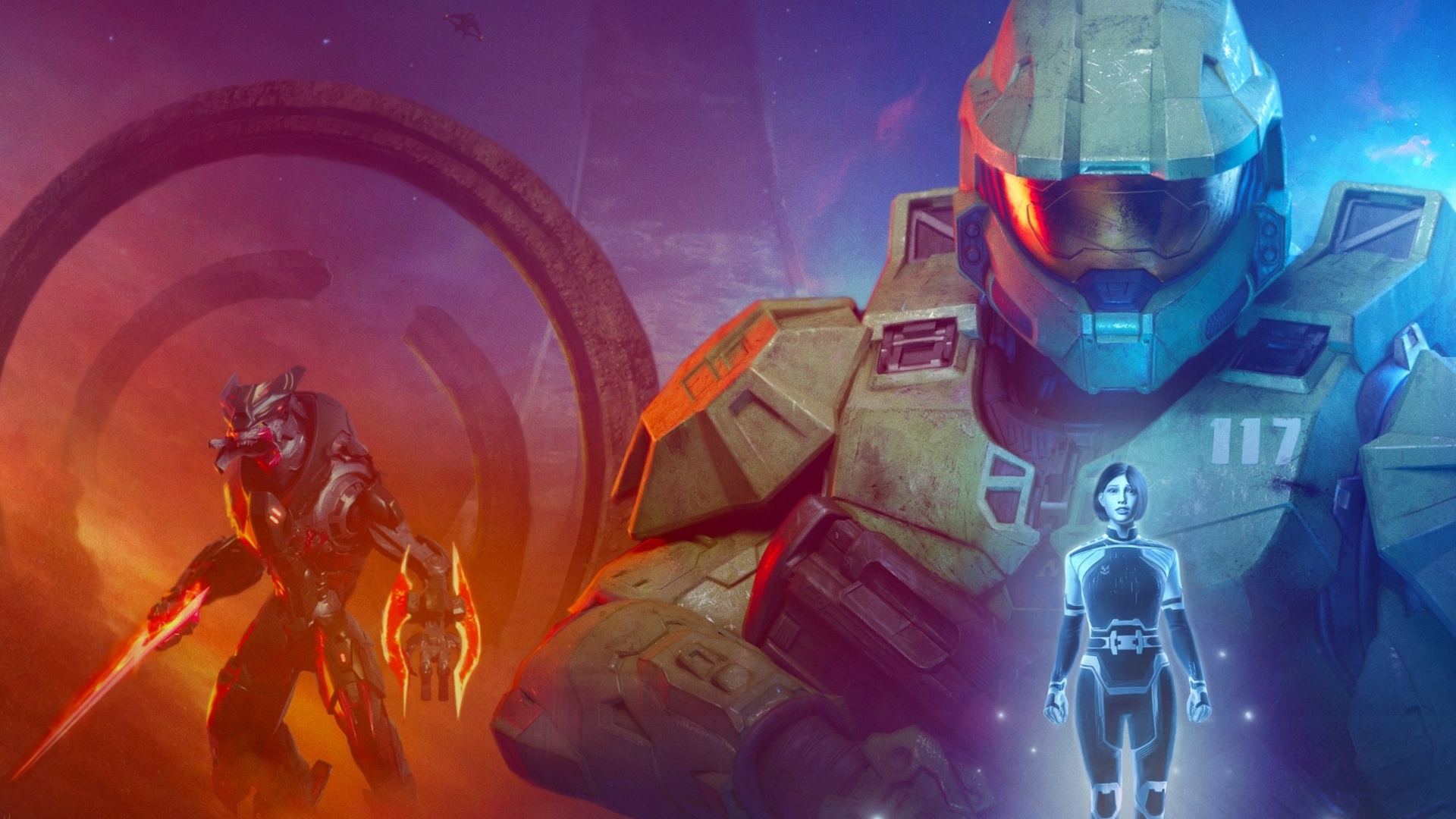

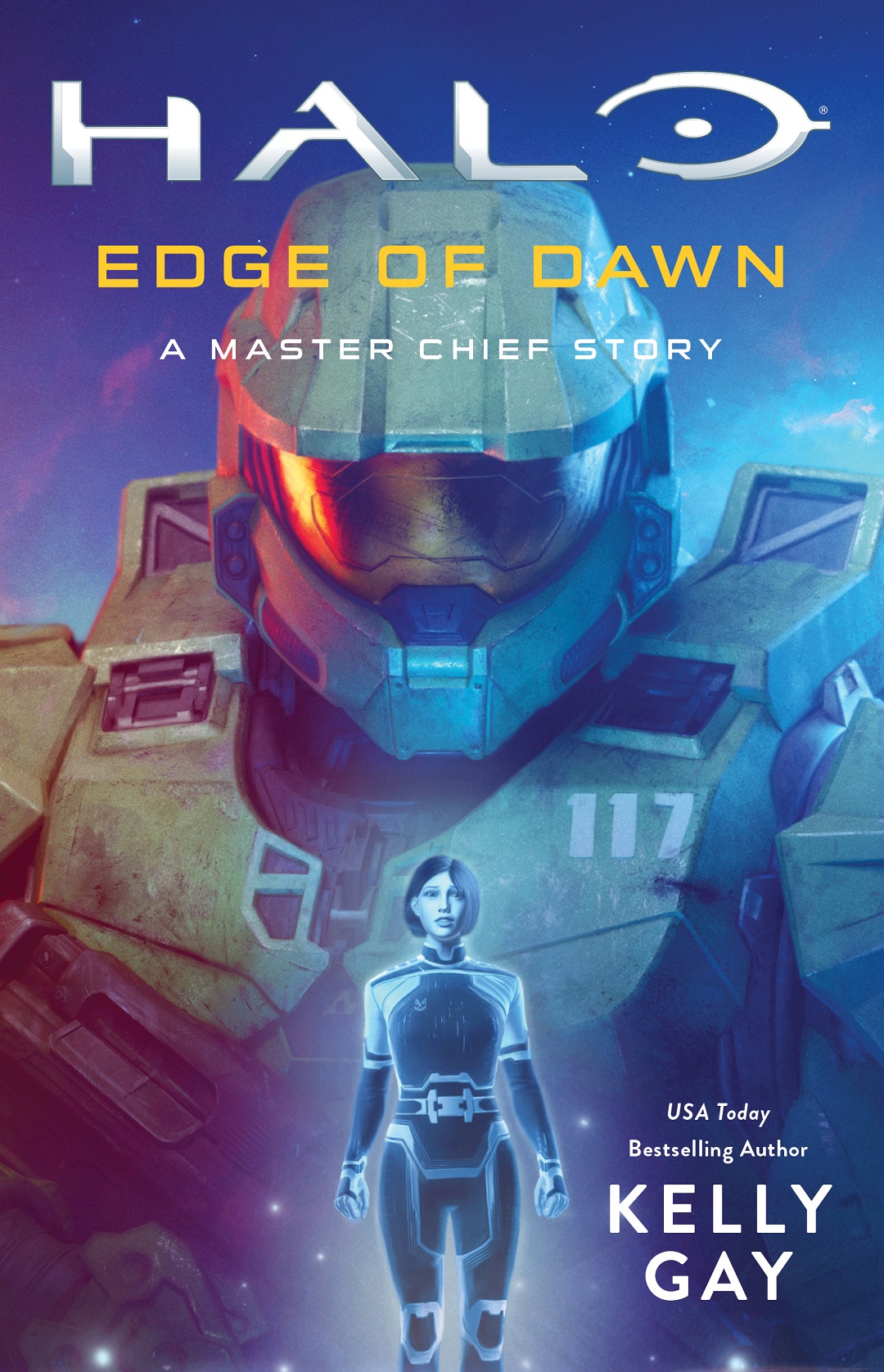
Halo: Edge of Dawn, the latest novel by acclaimed author Kelly Gay, releases on December 16, 2025.
Following on immediately from the end of Halo Infinite's campaign, Edge of Dawn tells an exciting new story with the Master Chief, his new AI companion Joyeuse (formerly known as "the Weapon"), and pilot Fernando Esparza.
The audiobook is narrated by video game voice talent:
- Nicolas Roye - Fernando Esparza, Narrator
- Jen Taylor - Joyeuse, Cortana, Dr. Halsey
- Steve Downes - John-117
- Debra Wilson - The Harbinger
Have a listen to a preview of the official audiobook below!
2560. After eliminating War Chief Escharum and sending the Banished leadership into chaos, the Master Chief continues the fight on Zeta Halo, accompanied by his new AI companion and their loyal pilot Fernando Esparza.
As Spartan-117 searches for scattered allied forces, a young combat medic—tortured and imprisoned for months by the Banished and the enigmatic Harbinger—may hold the key to unlocking deeper mysteries within this ancient ringworld. But every step toward answers is haunted by the sinister and elusive blademaster Jega ‘Rdomnai, who is hellbent on vengeance....
Halo: Edge of Dawn releases on December 16 and is available in trade paperback, ebook, and unabridged audiobook formats.
CHAPTER ONE
Silent Auditorium
June 3, 2560
The light from the portal filled his heads-up display, white and blinding. In an instant, the neural interface linking the Master Chief—Spartan John-117—to his armor’s systems went dark. No latent or real-time data populated across his HUD’s interior screen. He was blind in more ways than one, left with only the adrenaline of recent battle and the sound of his pulse still thundering in his ears.
Against the warning of the Weapon, the young artificial intelligence currently residing in the crystalline layer between his Mjolnir armor and inner padding, and with the Silent Auditorium collapsing around them, there hadn’t been time to question the portal’s sudden appearance or its origins, so he’d made the call and leapt into the unknown.
Only to be spit out in midair seconds later.
Immediately, his display cleared, revealing a dusk-colored sky before his screen filled with data that told him what he already knew.
He was falling backward. And fast.
No time to react, he crashed shoulders-first onto a mountain side, his armor taking the brunt as he slid down the jagged cliff top, all four hundred and fifty kilos of him busting through granite and schist and finally coming to a rolling stop on a flat ledge.
He lay there for a half second, numb to the pain, muscle fatigue, and hunger accumulated over days of intense combat. With a grunt, he pushed to his feet. “Let’s not do that again.”
“I did try to tell you it was a bad idea.”
John ignored the Weapon’s cheerful I told you so and stepped toward the cliff’s edge to get his bearings, gazing across the vast span of Zeta Halo’s inner surface, where a gaping hole had been blown into the ancient ringed structure six months earlier. The fiery glow from the nearest star illuminated the Halo’s distant debris field, a patchwork of islands, broken superstructure, and remnants of spent battles all caught in place by the ring’s artificial gravity.
The portal had taken them from the Silent Auditorium, deep within the interior of one of those islands, and cast them out here, moments later, clear across the ring.
His comms suddenly crackled to life. “Chief! Your beacon just appeared out of nowhere. Oh, I thought I’d lost you. Where did you go?”
“Echo 216?” the Weapon responded, clearly surprised.
She wasn’t the only one.
The fact that the Pelican pilot had managed to find them so far from where he’d initially dropped them off only a few hours earlier seemed almost impossible.
“Stay put,” Echo 216 said, “I’m coming to you.”
Dust blew across the barren rocks, drawing John’s gaze away from the cliff’s edge to what lay around him. “Where are we?”
As he turned, he saw that he stood in the shadow of a five-meter tall totem ring, one of seven stone rings lodged in a continuous line within the barren rock. Ancient and weathered, a few broken, the totems were carved with strange symbols and iconography, and contained data relating to Zeta Halo’s distant past. The Weapon had decoded several of these records during their short time on the ring and found the totems unnerving. Couldn’t say he blamed her.
“Chief, I think the better question is when are we,” the Weapon replied. “I don’t know how, but we’ve been gone for days. Three days, to be precise.”
In his decades of service to the United Nations Space Command, fighting the Covenant, the Flood, the Banished, Cortana’s Created, and countless other threats, he’d seen his share of uncanny alien technologies, but the revelation still caught him off guard.
“This ring,” he noted quietly, “is different than the others.”
Zeta Halo was part of the neoteric array—seven super-weapons created over a hundred thousand years ago by an ancient, technologically advanced species known as the Forerunners to combat the Flood. The parasitic hivemind had been sweeping through system after system, infecting world upon world. The Halo Array, fired in concert, was designed to eliminate the Flood’s food source—namely all thinking life in the galaxy. Nothing survived. To counter the horrific effects of their weapons and to later reseed life back into the galaxy after the Flood died out from starvation, the Forerunners had designed the Halos’ inner bands to house all manner of life, preserving flora and fauna specimens from across the stars in a multitude of habitats and genetic repositories. The rings contained vast archives of history, information, and technology . . . and some, like this one, held secrets even the Forerunners feared.
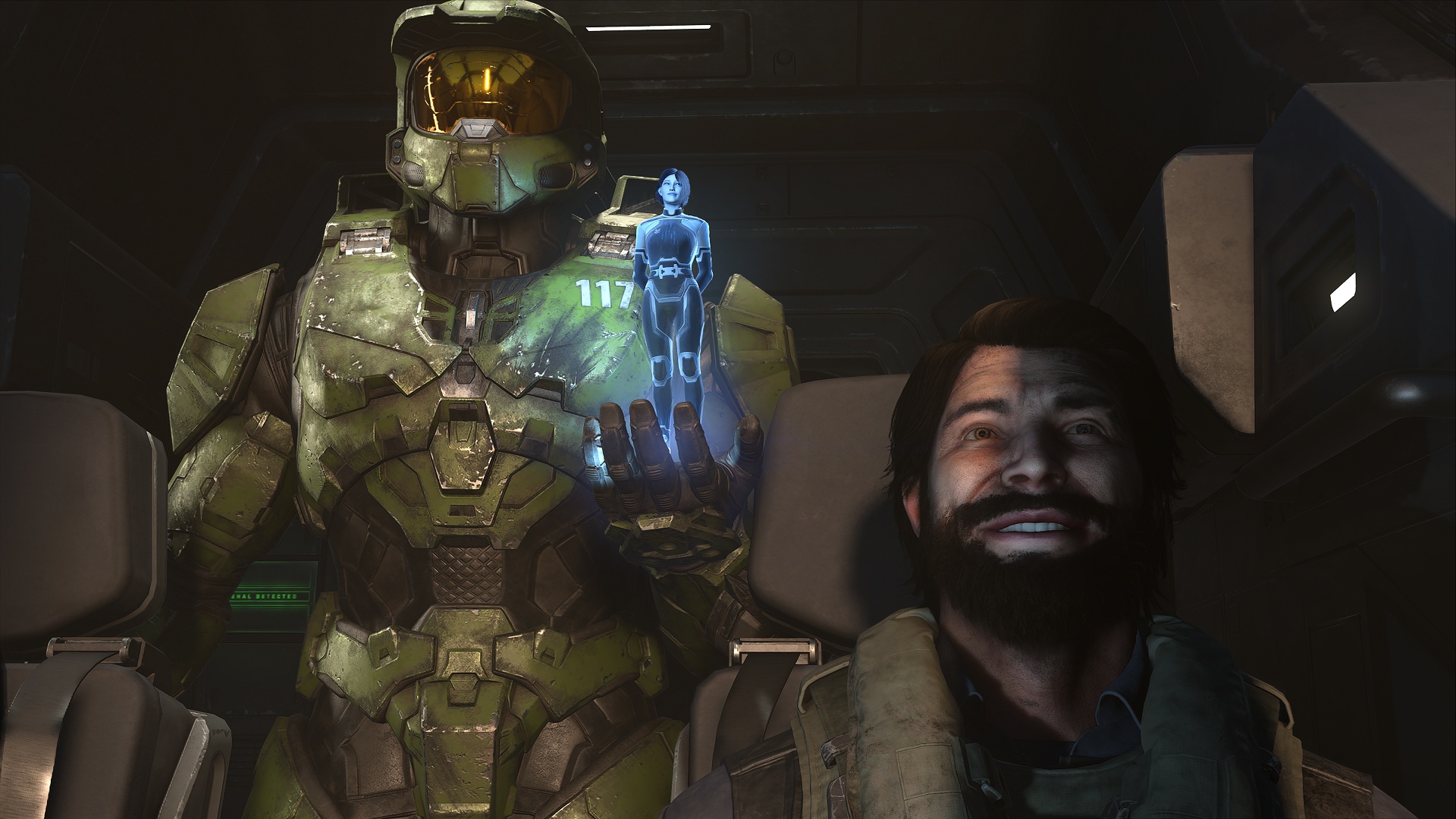
John sensed the soft nudge through his neural link and lifted his hand in response. The Weapon instantly projected her blue holographic form onto his open palm. Thirty centimeters tall, she was clad in a translucent UNSC bridge cadet uniform. Lines of code ran vertically through her entire body, growing luminous or dim depending on her mood, which for the most part was sunny and optimistic. Her face was impish, and she often tucked one side of her cropped dark hair behind her ear.
“The Banished and the Harbinger were looking for something that was never found,” she said, studying the archaic totems. “Why would the Forerunners hide something and throw away the key? Doesn’t that scare you?”
“No. You?”
The Weapon considered his question. “Of course not.”
A familiar whir filled the air as his comms buzzed again.
“Is anyone going to ask me what I think?”
John turned as a Pelican rose from the depths below the ledge to hover directly in front of him. The dropship’s windshield was cracked in places, its armor plating charred and dented and its chin gun completely inoperable, but the venerable D77-TC was still proving its worth.
“I guess not. Get inside, big guy,” Echo 216 said, executing a one eighty to put the Pelican’s back hatch a few meters away from the cliff ledge, its door already opening.
As the Weapon withdrew into his armor, John ran forward, leaping off the ledge and into the troop bay, the metallic clang of his armored boots echoing through the space as his momentum carried him toward the cockpit.
With autopilot engaged, Echo 216 unclipped his harness and hurried out of the cockpit to meet him, his arms outstretched to embrace the Spartan. “Chief! Chief!”
The hug was unexpected, but it told John how traumatized the man must have been in their absence.
The pilot had been existing in a constant state of fear for far too long. First, stuck alone in the ring’s orbit for six months, the dead floating all around him, while evading enemy patrols . . . then thrust into the ongoing battle on the surface, assisting John as he fought to regain control over the ring, a fight not without its consequences.
That, along with the last seventy-two hours, had taken their toll.
Though now the sudden appearance of Echo 216 made a bit more sense. The pilot hadn’t found them quickly at all; he’d been out searching for days, finally happening upon their signal.
“Sorry. I’m really happy to see you. Really happy.” Echo 216 stepped back, gazing up at John’s faceplate, a relieved smile breaking through his dark beard, before grabbing an MA40 assault rifle leaning against one of the troop seats. “So . . . what do we do now?”
The Master Chief took the offered rifle and attached it to his back, feeling the magnetic plate grab hold. “We finish the fight.”
The pilot laughed, punched the air, and then saluted, his animated behavior bordering on manic. It didn’t take a therapist to see the trauma lurking behind his excitement. “Yes! Yes, sir!” He headed back to the cockpit. “The Banished still control the rest of the ring—”
“Wait.” The Weapon appeared on John’s palm. “I know this is weird,” she said, “given all that’s happened, but . . .”
“What? What is it?” The pilot turned, his hand resting on the back of the flight seat.
“We still don’t know your name. We can’t keep calling you Echo 216.”
“No, you can’t.” He gave a genuine smile. “Esparza. Fernando Esparza.”
“It’s nice to meet you, Esparza. Fernando Esparza.”
“Good work, soldier,” John said, feeling somewhat guilty he’d never asked the question himself, given that his reliance on the pilot had put the man in danger many times. But he knew why he hadn’t. The war they’d been fighting, like all the other endless battles over the years, all the names and faces of marines and civilians, soldiers and friends . . . He’d gotten used to keeping people at arm’s length and knowing as little as possible. It was better that way.
“And what about you?” Esparza asked the Weapon.
“What about me?”
“What do I call you?”
She turned away from Esparza, uncertainty in her expression. “Any ideas?” John asked.
“Well . . .” She put her hands behind her back as she considered it, then: “Do you think it would be okay?”
He nodded. The naming of oneself was a privilege granted to all smart AIs. This one, however, had been the exception. The Weapon had been created for a single purpose; a critical mission she wasn’t meant to outlast. But now that she’d be hanging around for a while, the choice was all hers.
“You’re sure?” she asked.
“You get to choose your name.”
“Then . . . I think . . .” She pivoted back to Esparza, smiling. “I think I might have the perfect one.”
Esparza slid into the pilot’s chair and locked it into place. “All right. Here we go.” John took up position behind the seat. With a glance over his shoulder, Esparza laughed and then pushed the throttle. “Get ready. . . .”
Hugging Zeta Halo’s inner curve, the Pelican flew at subluminal speed back toward the fracture. John linked his HUD to the dropship’s radar, keeping a close eye on its long- and short-range sensors. Most Banished forces seemed to be concentrated in the area of the ring’s debris field where the heaviest fighting had taken place over the last six months, but scouting parties and patrols could be anywhere on its surface. And without an operational chin gun, they’d do well to steer clear of Banshee patrols or anti-air guns.
“What’s it been like the last three days?” John asked, though he had a feeling he already knew. He’d killed the Banished leader Escharum before heading into the Silent Auditorium and facing the Harbinger. The blowback would have been significant.
“It’s not good, Chief. After you took out Escharum, the Banished went berserk. Well, more berserk than usual. They’ve been broadcasting mass prisoner executions over their comms towers. Making a real spectacle. They’ve retaken a few of the FOBs you guys liberated. Some of the Banished are even turning against the human factions within their own ranks.”
“Chief ?” The Weapon’s concerned gaze told him she was aware of the spike in his limbic system.
He’d expected retribution for the Banished leader’s death, but he hadn’t expected to be MIA for three days while UNSC forces sat in the cross-hairs, paying the price—just as they’d had to do when he’d been adrift in space and unable to join the fight. “I’m supposed to take the brunt. I can handle it. There are too many out there that can’t.”
“It’s not your fault,” she replied carefully.
“I know.” But knowing didn’t make the situation any less frustrating.
“There’s no leadership,” Esparza continued in an obvious attempt to redirect the conversation. “Word is that’ll all be worked out tomorrow.”
“What happens tomorrow?” the Weapon asked.
“The last day of Escharum’s funeral. Stay frosty, my friends, we’re approaching the break. This is Banished territory.”
Several kilometers out, islands began to take shape within Zeta Halo’s massive fracture, many of which had retained their topography in the cataclysm—rocky terrain, high-altitude forests and meadows, a few small lakes, and scattered clusters of hardy vegetation still flourished beneath a manufactured atmosphere and gravity—while other small fragments were nothing more than chunks of exposed pillars and alloy substructure, stripped bare in the explosion, revealing the complex machinery and vast under world that existed within the ring.
Even from this distance, signs of occupation dotted the debris field; the faint glow of fires and long threads of smoke rising into the atmosphere marked clear indications of life, any one of which might be human, might be the members of his team. John had no doubt that Blue Team—Fred-104, Kelly-087, and Linda-058—were out there somewhere, just as he felt certain that Dr. Halsey, Spartan Commander Sarah Palmer and Infinity’s captain, Thomas Lasky, had survived and were even now making inroads to take back Zeta Halo from the Banished. Hundreds of Spartans had been aboard the flagship when she’d entered the ring’s orbit. But with the Banished routinely jamming UNSC comms, it was difficult to know just how many had survived the initial ambush and how many were still alive after six months of relentless fighting here on the surface.
As much as he wanted to search for Blue Team and the others, he had to take advantage of the power vacuum created by Escharum’s death before losing the opportunity altogether.
“Without UNSC leadership and a clear centralized command, Rubicon Protocol is still in effect,” the Weapon said, in line with his thoughts.
“What’s Rubicon Protocol?” Esparza asked.
“It’s permission to act,” she answered. “To do what needs to be done to keep Zeta Halo out of enemy hands and prevent a new leader from rising out of the ashes. Whatever it takes.”
“‘Whatever it takes,’” Esparza echoed. “I’m afraid to ask what that entails. Never mind. I don’t want to know.”
“It means we’re going to fan the flames, sow chaos and division,” John said. “Then we use the distraction to sever Banished communications and jamming towers and restore UNSC comm sats so survivors can start communicating and regrouping.”
“Chaos sounds fun,” the Weapon responded, grinning at Esparza. “Doesn’t it?”
“Oh, so much fun. Just drowning in fun,” he muttered, rolling his eyes.
The dropship continued its descent toward the edge of the fracture and the familiar alpine landscape that made up the broken fragments of the ring. The unknown system’s nearby sun had set, leaving behind an evening sky with thin clouds and the maw of space lurking beyond.
“So now that you know my name”—Esparza glanced over at the Weapon—“you plan on sharing this perfect name of yours?”
John lifted the Weapon higher as she linked her hands behind her back and cocked her head, a slow mischievous grin building on her pert face.
“It’s . . . Steve.”
Esparza blinked. “Steve?” he echoed after a dumbstruck moment. His brow furrowed as he glanced between them. “Are you serious?” When she didn’t respond, he said, “Of all the random names . . . Chief, come on, are you hearing this?”
John shrugged. “I like it.”
“What’s wrong with Steve?” Steve blinked innocently.
“I just . . . it doesn’t . . . I mean . . .” Esparza stammered in credulously until the Weapon burst with laughter.
“You should see your face.”
Esparza’s shocked expression gradually shifted, becoming a grudging smile. “Ha-ha. You got me. Very funny.”
“Oh, trust me, it was.”
She turned her head and caught John’s attention, the wide grin on her face sweeping through his chest like a solid punch to the solar plexus.
She looks just like her . . . His own words to Dr. Catherine Halsey were ingrained in his memory. In her lab on Infinity, she had shown him “the Weapon.”
. . . “If you say so. I see something else. Something more innocent . . . from a simpler time,” she had said.
“Does she know me?”
“No. She is a blank slate. No memories, no history. Her core is nearly complete. Once it is ready, it will be up to the two of you. The Weapon will lock her down. You will retrieve Cortana and bring her back here.”
“For execution.”
“For deletion. We are at war, Master Chief. If you do not think you can do this . . . now is the time to step down. I am sure Spartan Locke is available.”
“That won’t be necessary.”
“Good. Tomorrow will test us all.” . . .
Dr. Halsey had been right—as usual.
They’d been tested.
Tested and failed.
He stowed the memory and turned his attention back to the Weapon. “Did you decide?”
“Mmm. I did.” Her shoulders went straight, and she said with confidence: “I’m UNSC AI Serial Number CTN 0453-0. Name designation: Joyeuse.”
“Hmm. Not as good as Steve, but . . . I like it,” Esparza said, giving her a wink.
John knew there was a chance she might have called herself Cortana, and while he would have supported her decision, he couldn’t deny the strong feeling of relief that swept through him. Holding on to a name that carried so much history and unresolved grief would have been . . . difficult.
The clearing of Joyeuse’s throat drew his gaze to hers once more. She was waiting, wanting to know what he thought.
John dipped his head. “I like it too. It suits you.”
She smiled. “Thanks.”
“Joyeuse . . .” Esparza mulled it over. “Never really heard a name like that before. What does it mean?”
“Well, among other things, it means good-natured, with a really amazing personality. Describes me pretty well, don’t you think?”
“I think you’re right then—it is perfect.”
“Precisely,” she said, pleased.
“You know, my wife loved unique names too. When we chose our daughter’s name, Iahlee, oh man, it took forever. Nothing felt right.”
“So how did you choose?”
“Well, right up until the day she was born, we couldn’t decide. And then she was there, in the world, this perfect little being, and it all just clicked. I guess it took meeting face-to-face to really know—hold on,” he said, hard-banking the Pelican around jagged pillars jutting from the side of a barren mountain peak.
As they talked names, John’s mind took him back to the first time he’d met Joyeuse’s predecessor. Her matrix had poured into the neural interface implanted in the back of his head with a sharp, icy stab. That initial feeling had been unexpected—as was hearing another internal voice besides his own, coexisting and speaking in his mind. . . .
“Not a lot of room in here. Hello, Master Chief. . . .”
“Hello, Cortana.”